ABOUT BOOKS No. 4.

THE FIVE HUNDRED BEST ENGLISH LETTERS edited by LORD BIRKENHEAD

This is ANNE BOLEYN’s (1507 – 36) last letter, and it is to the man who had ordered her death, KING HENRY VIII.  Henry had given up the wife he had lived with for twenty years, Catherine of Aragon, his brother, Arthur’s widow, so that he could marry Anne.  He not only broke with Rome for her, he also faced the anger of the great powers of Europe.  Yet here is Anne, two years after her marriage to him, writing a passionate and heart-broken letter whilst waiting for her death.

This is only an excerpt from the letter but it makes for very sad reading.

‘Sir, Your Grace’s displeasure and my imprisonment are things so strange unto me, as what to write, or what to excuse, I am altogether ignorant……

But let not your Grace ever imagine that your poor wife will ever be brought to acknowledge a fault which not so much as a thought thereof proceeded. And to speak a truth, never prince had a wife more loyal in all duty, and in all true affection, that you have ever found in Anne Boleyn…..

You have chosen me from a low estate to be your queen and companion, far beyond my desert or desire.  If then you found me worthy of such honour, good your Grace, let not any light fancy or bad counsel of mine enemies withdraw your princely favour from me; neither let that stain, that unworthy stain, of a disloyal heart towards your good Grace, ever cast so foul a blot on your most dutiful wife, and the infant princess, your daughter…..

My last and only request shall be, that myself may only bear the burden of your Grace’s displeasure, and that it may not touch the innocent souls of those poor gentlemen who, as I understand, are likewise in strait imprisonment for my sake.  If ever I have found favour in your sight, if ever the name of Anne Boleyn hath been pleasing in your ears, then let me obtain this request;  and I will so leave to trouble your Grace any further….

From my doleful prison in the Tower, this 6th of May.  Your most loyal and faithful wife, ANNE BOLEYN.’

Anne was beheaded by a French swordsman on the 19th May.

ABOUT BOOKS No.3

northern musetartan burns

ROBERT BURNS POETRY

THE NORTHERN MUSE (An anthology of Scots vernacular Poetry)

I’ve had a very small red tartan covered book of Robert Burns poems for years and years, from the days when I was a very impressionable girl in love with poetry. Again, it is a bit battered because it’s been handled and read so much. It is one of my most loved books but now I come to find it today, it’s nowhere to be seen. It had one of my favourite poems in it, ‘My love is like a red red rose,’ but having said that, when I look it up in The Northern Muse, (which is edited by John Buchan who wrote The Thirty Nine Steps) I find the real poem begins, ‘O, My luve is like a red, red rose,’ which makes it somehow more heart-breakingly lovely.

Burns was born in 1759 and died in 1796. His father was an unsuccessful tenant farmer in Ayrshire and life was very hard for all the Burns family. I can understand Robert turning to poetry to offset some of the hardness of that life.

Here’s the poem:

O, my luve is like a red, red rose, / That’s newly sprung in June: / O, my luve is like the melodie / That’s sweetly played in tune.

As fair art thou, my bonnie lass, / so deep in luve am I: / And I will luve thee still, my dear, / Till a’ the seas gang dry.

Till a’ the seas gang dry, my dear, / And the rocks melt wi’ the sun: / And I will luve thee still, my dear, / While the sands o’ life shall run.

And fare thee weel, / my only luve, / And fare thee weel a while! / And I will come again, my love, / Tho’ it were ten thousand mile!

My computer doesn’t like the dialect in this poem and is underlining words with wiggly red lines as fast as it can. ‘Weel,’ is as you have guessed, ‘well.’

I remember reading the line ‘And the rocks melt wi’ the sun:’ in such absolute astonishment at this deep and beautiful image, that I felt somehow I had moved from one world to another. It affected me very much. It was like seeing Burns’ soul written on the page.

It still has the same effect now.

ABOUT BOOKS 2.

penguin book

ABOUT BOOKS 2.

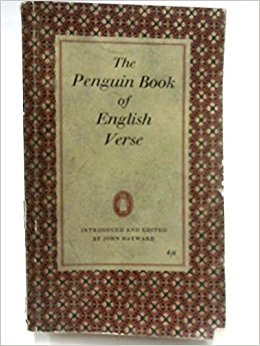
On a bitterly cold and snow laden day and looking for something cheerful, I searched my bookshelves for my ancient copy of The Penguin Book of English Verse, which cost 4/6d so many years ago. This book is so old, it’s in pieces. Small children have, at some time or other, drawn rings and very tall stick figures on what is left of the back page. In the middle of the book, I found a drawing of a fire engine and a house. There is only a tattered front cover, the back cover has vanished, so the lovely book above is not the one I have!

But I was looking for two poems. One was Auden’s ‘Lay your sleeping head, my love,’ and the other was Marvell’s ‘To His Coy Mistress.’ These poems have been such good companions for so many years that even when they present themselves on really old and brown edged paper that will tear in an instant without careful handling, they never fail to cheer. It’s the exquisite telling that makes a celebration of life.

Here’s the first verse of Auden’s poem:

Lay your sleeping head, my love, / Human on my faithless arm; /Time and fevers burn away / Individual beauty from / Thoughtful children, and the grave / Proves the child ephemeral: / But in my arms till break of day / Let the living creature lie, / Mortal, guilty, but to me / The entirely beautiful.

And here’s the first few lines of Marvell’s poem:

Had we but world enough, and Time, / This coyness Lady were no crime. / We would sit down, and think which way / To walk and pass our long Loves Day. / Thou by the Indian Ganges side / Should’st Rubies find: I by the Tide / Of Humber would complain…..

Wystan Hugh Auden born 1906 died 1973and the Editor, John Hayward, has this poem written on lst September 1939.

Andrew Marvell born 1621 died 1667.

ABOUT BOOKS No.1

ABOUT BOOKS No.1.

On a freezing winter afternoon, looking over the fields only gives the view of swirls of fog pushing into the garden, over the gate and into the apple tree.    

Last year, I bought Vol.1. of Walter Benjamin’s Selected Writings 1913-1926 and have been reading his essay on ‘A glimpse into the world of Children’s Books’ which is extraordinarily interesting. In the middle of this essay there is an absolutely lovely nursery rhyme from an old German picture book, ‘Steckempferd und Puppe’ (Stick-Horse and Doll) by J.P. Wich.

This rhyme tells of all the things a little child sees in a town and, in particular, how the child sees a cat.  The rhyme ends with the enchanted child thinking what a lovely little place the town is and, ‘I’ll make a note of that.’  There are many such lovely little places and, whenever I find myself in such a town, like the child in the story, I, too, ‘make a note of that.’      

I do wonder who else but Walter Benjamin would introduce an essay on children’s books with this quotation –‘A soft green glow in the evening red.’ by C.E.Heinle, but this is the thing about books and writers.  They bring such joy and delight with them.