WHEN YOU WERE HERE

              WHEN YOU WERE HERE

 When you were here
There were hollyhocks in the garden.
Your shadow passed the house,
Stopping before the red lights
Of the Station crossing.
I saw you everywhere then.
The flap of your coat round a distant corner,
Your green shirt adding a leaf
To the darkness of a familiar tree.
In your buttonhole you wore a bright red poppy,
Those blazing flowers that now I give to you
As once you gave to me. 

Still I see you.
There is no road, no court, no turning in this town
That does not carry the imprint of your sandalled foot.
No fence, no wall, no plot that does not hold
The memory of your dark and curious eyes. 

When you came home after the war was over,
You carried me around this town upon your shoulder,
Until I, too, recognised each old leaf and stone
And your friend’s faces I knew almost as I knew your own.        

But now you’re gone,
And all those things you taught and told me,
Which were as close to me as my blood,
Have faded in the bleaching touch of our lost sun,
Except my knowledge of you,
And of your love. 

                                        © 2019 Gwen Grant


ONCE AGAIN

         ONCE AGAIN

I am sick of this page,
Staring at me in all its whiteness,
Never once blinking,
Never once having the courtesy
To fill itself with lines of writing.

                                ©2019 Gwen Grant

WALLFLOWER ROCK AND ROLL

 I went dancing a lot when I was young and as it was the time of Rock and Roll, that was part of the dancing I did, as well as the waltz, the tango and other favourites that had you up and on the floor from the first chord of music.  As a younger child, I was taught tap dancing and ballet and wanted nothing more but to dance.  I have such brilliant memories of those days and did tap dancing for years.  Whilst I still rock and roll, however, it’s in a very polite and sedate manner with a nod here and a twirl there whilst I’d absolutely much rather be whirling and swinging!

     WALLFLOWER ROCK AND ROLL

Buying roses and chrysanthemums
From the woman in the market,
I ask if there are wallflowers,
This morning up for sale.
Wallflowers! says she.  Why, there are bunches
In a box lying just around the corner,
Small and compact plants, to make a garden sing.
But there are no long and leggy gilly-flowers
With their scented velvet petals,
In reds and yellows, oranges, and crimsons dark as blood,
For no-one wants this lady.  No-one wants to take her.
She has to flower and blossom in the shadows on her own.

We were standing down along
From the old and ravaged dance hall
That used to be our golden home in all those years gone by
When quick as a curve in time,
The dance hall years sprang out at me.
With throb of drum and splintered icy glitter of guitar,
A fevered trumpet singing silk; the sax’s cool desires,
Then harsh and sweet the singer sang,
And so the dance raged on and on.
Rock!  Rock!  Rock!
Until the street began to swing,
With fast ecstatic dancers in fast ecstatic dance.

No wallflowers in that dance hall, no little flower alone,
For short and compact, long and leggy,
They’re out there dancing on their own.
Rolling with the rest of them, rocking with the best of them,
The swirling, whirling girls with their flaring, sexy petticoats,
On their moving, grooving heels so high; stiletto thin,
They can balance on a silver coin,
Rocking angels dancing on the head of any pin.
Hot rock with grace, with love and passion,
For though they think they own the dance,
They know the dance owns them.

No wallflower lad stands all alone
As Princely in his thick soled,
Suede, and mighty brothel creepers,
Cool and smooth in bootlace tie and Lamming gown,
With Tony Curtis curl of hair slickly curling down.
Young lions they stand, fierce, on the prowl.
Aloof and fabulous in their time,
Until the music bolds their blood,
Guitar and trumpet, sax and drum,
When flesh and skin and bone give in,
To make the dance hall sway and swing
To flirty, dirty, rock and roll.
ROCK ON! 
                             ©2017 Gwen Grant

DISCONTINUED LOVER

                   
DISCONTINUED LOVER

This was the night when the heart was broken,
When stars collided and fell into gardens,
Fell into dark streets and lamplit highways,
Into houses with slammed doors and rooms
Full of emptiness,
Where shadows walked in perfect safety
With no-one there to tread on them.

Outside, the yellow light from the tall street lamp
Threw gold over the green bushes and leaves,
Over the leaves dripping greenness into the darkness.
And search as you might,
No spilt blood could be found on the ground.
Spilt only in the heart of the discontinued Lover.

Who whispered and sighed,
Lamented and cried,
At how suddenly everything was lost and broken.
Perfectly willing to grieve for ever.
Wake up!  Look at the calendar.
Your play day will soon be over.
Madness to waste the eyes, the heart, that willing body,
For what is now a shimmering chimera.

Better to see how even the darkest leaf is etched with gold.

Just get going.

                                                © Gwen Grant

POETRY REVIEW and BLOODAXE BOOKS

ruth stone

Ruth Stone

I was asked by WRITERS REVIEW to choose any book I wanted and review it. This was such a lovely request that, although I went to my bookshelves, dithering over other books, it was actually always going to be ‘What Love Comes To’ by the American poet, RUTH STONE.  It’s a rare day I don’t read a Stone poem.   

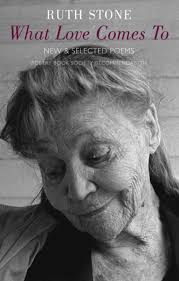
This Review was picked up by Bloodaxe Books and reprinted on their website. Bloodaxe is a brilliant poetry magazine.  The American cover, which is of Ruth Stone herself, is the cover Bloodaxe used and it can all be found here: https://www.bloodaxebooks.com/ecs/product/what-love-comes-936.

 ‘WHAT LOVE COMES TO’ New and selected poems by RUTH STONE

 The American poet, Ruth Stone, writes poems that shine with clarity, understanding and beauty, poems which  I absolutely love and admire for  their finely balanced, rhythmic elegance.  Stone is witty, wise and, at times, funny, but she can also be a very tricky customer, for she has this great gift of being able to change course mid-poem, so that what seems all set for plain and simple will, quietly, unexpectedly, lead into much darker waters.  It’s like being mugged by a feather.  You don’t know it’s happened until you reread a poem and find something new in it that you somehow missed before.  Every Stone poem is a journey into a new understanding for she is a force of nature, a poet in possession of her world and ours.

 In SECOND-HAND COAT, she begins with two words then in the following twelve short lines, turns this poem about an old coat into a surreal story of how, once it is taken home, it begins to talk, asking solicitously if its new owner has everything they need before leaving the house, the distinct impression being that it is speaking in the voice of the woman who once owned it.  Alchemy of the highest order.

 ‘WHAT LOVE COMES TO’ is made up of new poems and poems selected from earlier books, witty, acerbic, hostile, elegiac, fierce poems, some political, some absorbed by science, some with rough sexual imagery, some deeply sensual and some so tender, you can hear the poet breathing, feel her heart beating. 

 All Ruth Stone’s poems have such integrity, you trust her to tell it how it is, which is a tall order for a woman who was no stranger to tragedy.  Early in their marriage, Stone’s husband, Walter, killed himself, leaving her with three small girls to raise.   She has said that all her poems are ‘love poems written to a dead man,’ whose suicide forced her to live in limbo. Yet Stone keeps this compact of honesty between herself and the reader, sparing herself nothing and, therefore, sparing the reader nothing.  In TURN YOUR EYES AWAY, so hard to read, so impossible to think of how hard it must have been to write, the Gendarme notifies her of the nature and death of the man she loved.

 Each plain and unforgiving line of TURN YOUR EYES AWAY stonily taps into the next line, telling the bleak sorrow of how Walter died.  Of what happened when they pushed the door to his room open, of where his dead feet lay, then going on remorselessly to where his tagged body lies in the morgue.  Then, almost before there is time to feel sadness for such suffering, Stone whirls around, remembering  how they once lay together in a single bed, face to face, breath to breath, not wanting ever to part, that erotic love poem, the Song of Songs, lying open in the hotel’s Gideon Bible.  

It is through Ruth Stone’s absolute honesty and unflinching gaze in this poem as in all her poems, that in these last lines, we are able to feel the passion and sexual desire these two had for each other; a love that seems to shatter sorrow, swipe death out of the way and burn up the page with longing. 

In THE SPERM AND THE EGG, another mid-course change poem, the egg hates the sperm and then the sperm hates the egg, wanting its tail back because then it was free.  Dark waters here, for every reading throws up new thoughts.  It is Ruth Stone’s genius that this poem ends with an absolutely apposite quotation from Hamlet.   Then the lovely humour of SETTING TYPE, where the semi-colon, the paragraph, the vocabulary and good punctuation get it together.

 Finally, from THE WIDOW’S MUSE, Poem XLII tells how the widow is triumphant having got through thirty years of widowhood, until her muse forces her to smell an old undershirt of Walter’s, which still retains his scent.  At this, the widow whimpers with grief whereupon the muse knocks all the sense out of her.  Harsh, hard and truthful.

 Ruth Stone, who died aged 96, in 2011.

© Gwen Grant   2019